Wednesday, March 31, 2010

The Pre-Computing History of the Computer

Today AHA Today points to online exhibits from the Computer History Museum. The image below, showing Pascal’s Pascaline and Leibniz’s Stepped Drum, is from Visible Storage: Samples from the Collection: “These samples from the Computer History Museum's large collection span the history of computing from pre-computing to supercomputing.”

Tuesday, March 30, 2010

The Archaeology of Academia

From the editors of Beneath the Ivory Tower: The Archaeology of Academia (Inside Higher Ed):
Conducting archaeological investigations on a college or university campus is important for a number of reasons. All of these relate to making the university’s past relevant both to its ongoing role as an institution as well as to its students, faculty, alumni, and other members of the larger university community. …

All schools, colleges, and universities have a land base. Under those campuses may be preserved evidence of prehistoric, nonacademic, or early academic life. These are natural laboratories for the study of local and institutional histories and should be used for education and research … [these] stories need to be told and archaeology can tell stories that were never recorded in campus newspapers and official histories.
Image: Pompey's Pillar, Alexandria, Flickr Commons.

Monday, March 29, 2010

Keeping Track of Where Information Is Located

From The Chronicle’s Wired Campus blog: Students Retain Information in Print-Like Formats Better”:
The report, "To Scroll or Not to Scroll: Scrolling, Working Memory Capacity, and Comprehending Complex Texts," described how two groups, of 20 students each, wrote essays after reading materials in either in print-like or scrolling formats. Those given the scrolling versions to read had poorer comprehension of the material.
If memory itself is the problem, then there is this: “Can't get rid of your memories? Call Death Bear” (LA Times).

Thursday, March 25, 2010

Research Libraries at Risk?

OCLC Research has released a new report, “Research Libraries, Risk and Systemic Change.” Here are the risk clusters it identifies (9):


The report suggests two main strategies for mitigation: shared infrastructure and restructured workflows. While these strategies are emerging, the report concludes with this:
Most institutions continue to direct resources in traditional ways towards operations that are marginal to institutional and national research priorities, towards processes and services that are ignored or undervalued by their clients and towards staff activities that are driven more by legacy professional concerns than user needs. To properly respond to the risks identified here, research libraries need to come together around an action agenda aimed at improvement of the research enterprise they serve. Incremental revision of traditional operational models will only hasten the movement of important new research services to other entities within the academy, leaving the library with only the vestigial values of its book-determined legacy. It will look the same but everything will have changed.

Tuesday, March 23, 2010

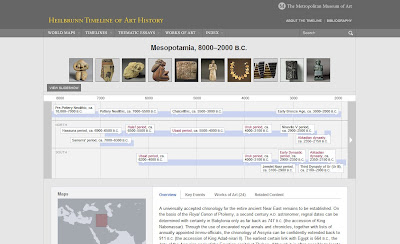
Mapping Time

I’m fascinated by the relationship between texts and time, so it was a thrill to receive recently a copy of Cartographies of Time: A History of the Timeline (Princeton Architectural Press, 2010), in which Daniel Rosenberg and Anthony Grafton provide “a short account of how modern forms of chronological representation emerged and how they embedded themselves in the modern imagination” (23). Although the timeline did not appear until modernity, “to clearly communicate the uniformity, directionality, and irreversibility of historical time” (19), this form of temporal representation is now “one of the central organizing structures of the contemporary user interface” (246).


Monday, March 22, 2010

Texts, Contexts, and Temporality

From Time

The article “Texts Without Context” (New York Times) reviews a number of books that “share a concern with how digital media are reshaping our political and social landscape, molding art and entertainment, even affecting the methodology of scholarship and research.” Themes of fragmentation—epistemological, communicational, and cultural—dominate. Near the end, the article quotes William Gibson, who claims that, “The record, not the remix, is the anomaly today. The remix is the very nature of the digital.” To which Jaron Lanier responds: “culture is effectively eating its own seed stock.” Are these examples of what the article calls Manichaean arguments?

The issue of cultural fragmentation reminded me of Manuel Castells’s “Museums in the Information Era: Cultural Connectors of Time and Space,” in which he argued that cultural heritage institutions such as museums can be “cultural connectors for a society which no longer knows how to communicate.” The preservation of temporality is of particular significance:

Museums are repositories of temporality. They constitute an accumulated historical tradition or a projection into the future. They are thus an archive of human time, lived or to be lived, an archive of the future. Re-establishing temporalities in a long-term perspective is fundamental to a society in which communication, technological systems and social structures converge to destroy time by suppressing or compressing it, or arbitrarily altering time sequences.

Wednesday, March 17, 2010

Exemplary Emulation

Accompanying the The New York Times article “Fending Off Digital Decay, Bit by Bit,” is a video showing an emulated environment in which researchers can explore one of Salmon Rushdie’s earliest computers.